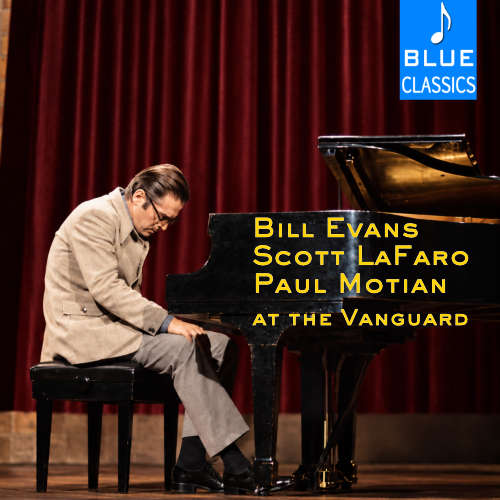
Title: AT THE VANGUARD
Year: 1961
Category: JAZZ,PIANO,BLUECLASSICS,LIVERECORDINGS
- 1. Gloria's Step 06:12
- 2. My Man's Gone Now 06:25
- 3. Solar 08:57
- 4. Alice in Wonderland 08:32
- 5. All of You 08:20
- 6. Jade Visions 03:55
- 7. My Foolish Heart 04:54
- 8. Waltz for Debby 07:00
- 9. Detour Ahead 07:38
- 10. My Romance 07:13
- 11. Some Other Time 05:05
- 12. Milestones 06:36
- Bill Evans – piano
Scott LaFaro – bass
Paul Motian – drums
Recorded June 25, 1961, live at the Village Vanguard, New York City
Producer: Orrin Keepnews
Recording engineer: Dave Jones

AT THE VANGUARD
by Bill Evans with Scott LaFaro, Paul Motian
On June 25, 1961, Bill Evans, Scott LaFaro and Paul Motian arrived at the Village Vanguard in New York City for a series of performances that would become some of the most important live recordings in the history of the piano trio. The three musicians had been working together since 1959, developing an approach in which piano, bass and drums operated as equal musical voices rather than as a soloist supported by a rhythm section.
Their earlier studio recordings, Portrait in Jazz and Explorations, had already established the character of the trio. In the studio, Evans, LaFaro and Motian had developed an unusually open conception of ensemble playing. LaFaro's bass lines could move independently of Evans's piano, while Motian responded continuously to both musicians rather than simply maintaining a fixed rhythmic framework. By the time they reached the Village Vanguard, this interaction had become an integral part of their playing.
The Village Vanguard was particularly suited to this kind of music. The club's small, intimate room placed the musicians close to their audience, and the trio performed several sets throughout the day and evening. Producer Orrin Keepnews and engineer David Jones recorded the performances, preserving the interaction between the three musicians as well as the presence of the audience.
The repertoire performed that day drew together music from several different sources. Scott LaFaro's “Gloria's Step” and “Jade Visions” represented the bassist's own compositions. Bill Evans's “Waltz for Debby” came from his own repertoire, while the trio also worked with compositions by Miles Davis, Cole Porter, Victor Young, Richard Rodgers, Leonard Bernstein and others.
The opening of Sunday at the Village Vanguard immediately establishes the trio's characteristic interaction. LaFaro's “Gloria's Step” is followed by Gershwin and Heyward's “My Man's Gone Now,” and then by Miles Davis's “Solar.” The repertoire moves freely between the American popular song tradition, Broadway and film music, and modern jazz composition. Rather than treating these pieces as fixed arrangements, the trio uses them as frameworks for interaction.
One of the defining characteristics of these performances is the independence of Scott LaFaro's bass. His role is not restricted to outlining the harmonic progression or marking the beat. He frequently develops melodic material of his own, answering Evans's phrases and introducing ideas that alter the direction of the performance. Evans, in turn, leaves considerable space for the bass and drums, allowing the musical conversation to develop without forcing the piano into a dominant role.
Paul Motian's drumming is equally central to this conception. His playing is economical but highly responsive, using changes in accent, texture and intensity to interact with Evans and LaFaro. The result is a trio sound in which rhythmic movement can originate from any of the three instruments.
The second album drawn from the session, Waltz for Debby, begins with Victor Young and Ned Washington's “My Foolish Heart” and continues with Evans's “Waltz for Debby,” the trio's reading of “Detour Ahead,” Rodgers and Hart's “My Romance,” Bernstein's “Some Other Time,” and Miles Davis's “Milestones.” The selection demonstrates the breadth of the trio's repertoire while maintaining the same principle of collective interaction.
The performances of “Waltz for Debby” are especially closely associated with this trio. Evans had originally recorded the composition in 1956 as a solo piano piece, and the Village Vanguard performance became its best-known trio interpretation. The piece would remain an important part of Evans's repertoire throughout his career.
The recording of “Milestones” also demonstrates the connection between Evans's work with Miles Davis and the later development of his own trio. Evans had been a member of Davis's sextet during 1958–59, and his experience in that ensemble was an important part of his subsequent musical development. Here, however, Davis's composition is heard in an entirely different setting: without horns, and with the harmonic and rhythmic responsibilities distributed among three musicians.
The Village Vanguard recordings therefore represent the culmination of approximately eighteen months of work by Evans, LaFaro and Motian. Their studio recordings had established the trio's musical language; the Vanguard performances demonstrate how that language functioned in front of an audience, where the musicians could respond spontaneously to one another over extended performances. The surviving recordings preserve not simply three musicians playing together, but a highly developed system of musical communication.
The circumstances surrounding these performances give the recordings an additional historical significance. Scott LaFaro was killed in an automobile accident on July 6, 1961, only eleven days after the Village Vanguard session. The June 25 performances were therefore the final recordings made by the Evans–LaFaro–Motian trio.
LaFaro's death brought the trio to an abrupt end. Evans was deeply affected by the loss and subsequently withdrew from public performance for a period before eventually forming new ensembles. The Village Vanguard recordings thus preserve the original trio at the precise point at which its musical development had reached its highest level, immediately before circumstances brought the group to an end.
The two Riverside albums were assembled from this single day of performances. Sunday at the Village Vanguard was issued first in 1961, while Waltz for Debby followed in 1962. They were not conceived as two unrelated recordings: both were selections from the same June 25 session, and producer Orrin Keepnews recognized that the performances provided enough material for two complete albums. The resulting records offer complementary views of the trio rather than a simple first and second volume.
Together, these twelve performances document the final recorded appearance of Bill Evans, Scott LaFaro and Paul Motian as a working trio. The music is characterized by close interaction, rhythmic freedom, melodic independence and an unusually balanced distribution of musical responsibility. At the Village Vanguard, the approach first developed in the studio was captured in its most immediate setting: three musicians on a small stage, responding to one another in real time.
The result is the definitive recorded document of the Evans–LaFaro–Motian trio.
EU Public Domain Notice
The historical sound recordings included in this release are in the public domain in the European Union. Blue Music Group has created a new digital restoration and mastering of these historical recordings. The digital restoration and mastering by Blue Music Group are protected by applicable copyright and related rights. Rights may differ in other territories, including the United States. This release is not intended for distribution in the United States.
Cover artwork: The original photographic image has been legally assessed as being in the public domain in the EU following the expiry of the applicable 50-year term under Section 49a. The image has been restored, enhanced and colorized by Blue Music Group. © Blue Music Group. All rights reserved.